- หน้าแรก
- สินค้าของเรา
-
ข้อมูลทางเทคนิค
-
Strain gage
-
Strain Gage Basic Information
- What's a Strain Gage
- Types of Strain Gages
- Self-Temperature-Compensation Gages (SELCOM Gages)
- Major Properties of KYOWA Strain Gages
- Strain gage bonding installation procedure
- Strain Gage Wiring System
- Principles of Strain Gages
- How to Select Strain Gages
- Strain Gages with Pre-attached Lead-wire Cables
- Strain Measurement
-
Measurement Knowledge
- Misalignment Effect of Bonding Strain Gage
- Generating Calibration Value Based on Tip
- Resistance Change of Strain Gages
- Strain Gage Bonding Procedure
- Compensation formulas for strain gage
- Countermeasures against Failure in Initial Balance
- Influence of Insulation Resistance
- Temperature Effect on Lead Wire with 2-wire
- Compensation Methods of Temperature Effect
-
Strain Gage Basic Information
-
Transducers
- Transducers
- Basic information of strain gage type sensors
-
Measurement Knowledge
- Sensitivity Decrease due to Cable Extension
- Equation to Calculate Centrifugal Acceleration
- Connection to Calculate Average Output Voltage
- How to Obtain Proper Rated Capacity of Load Cell
- TEDS
- Advantages of Remote-Sensing Method
- Graphs to Obtain Power or Work
- Installation of Load Cell to Hopper or Tanks
- How to Obtain Accuracy of Load Cell-Based
- Measuring Instruments
- Videos for how to use KYOWA products
- Unit Conversion Table
- Glossary
- FAQ
-
Strain gage
- ดาวน์โหลด
- ข่าวสาร l กิจกรรม
- บทความ
- เกี่ยวกับเรา
- ติดต่อเรา
- ลงทะเบียน
- Sensitivity Decrease due to Cable Extension
- Equation to Calculate Centrifugal Acceleration
- Connection to Calculate Average Output Voltage
- How to Obtain Proper Rated Capacity of Load Cell
- TEDS
- Advantages of Remote-Sensing Method
- Graphs to Obtain Power or Work
- Installation of Load Cell to Hopper or Tanks
- How to Obtain Accuracy of Load Cell-Based
Usually, it is desirable that a total weight including the tare of hopper or tanks is evenly loaded onto each load cell. If the loading point moves and the centroid is not fixed, estimate the locus of the centroid and referring to the typical position, arrange each load cell so that a maximum load is evenly applied to on each load cell. Also, select load cells of which the rated capacity is enough to cover the expected maximum load.
There may be two installation methods: standard and simplified. With the standard method, a load is wholly received by only all load cells. With the simplified method, a load is received by combinations of load cells, dummies, pivots and hinges. General installation methods of hoppers and tanks are shown in the below table.
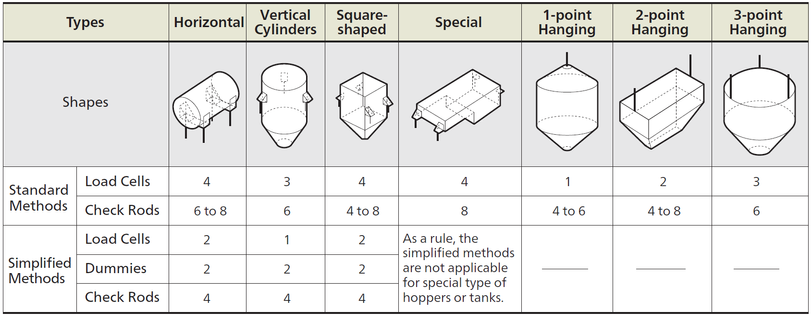
Features of Standard Method
- Load cells receive the whole load, thereby enabling measurement with minimal effect of fluctuation of the centroid.
- Applicable to most substances: solid, powder, or liquid.
- Measurement accuracy receives minimal effect of external factors such as temperature, vibration and installation conditions.
- Accuracy of load cells is fully utilized.
Features of Simplified Method
- Reasonable price due to dummies and hinges.
- Applicable to only liquid substances.
- Difficult to be used in special types of hoppers and tanks and inapplicable to tanks and hoppers which centroids move.
- Subject to adverse effects of vibration and temperature.
- Hinges should be installed carefully.
- Subject to adverse effects of vibration and temperature.
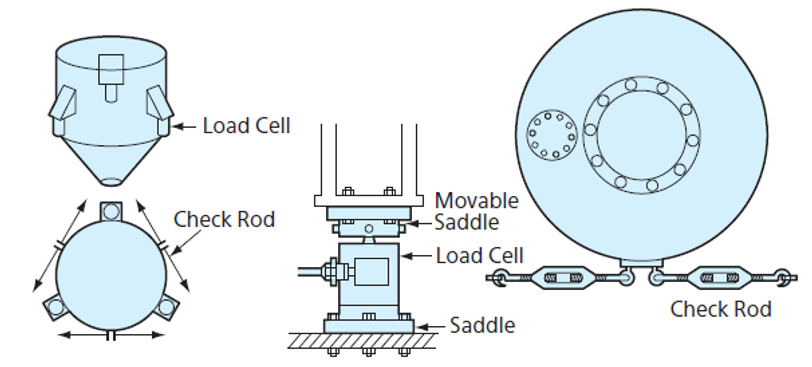
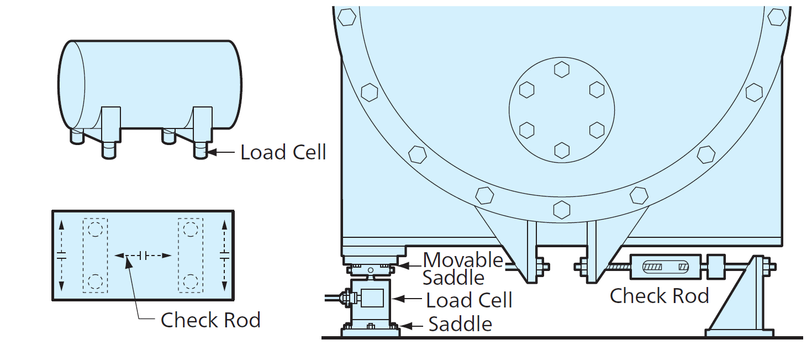
Typical Installations of Load Cell
Vertical Cylindrical Tank
Horizontal Tank
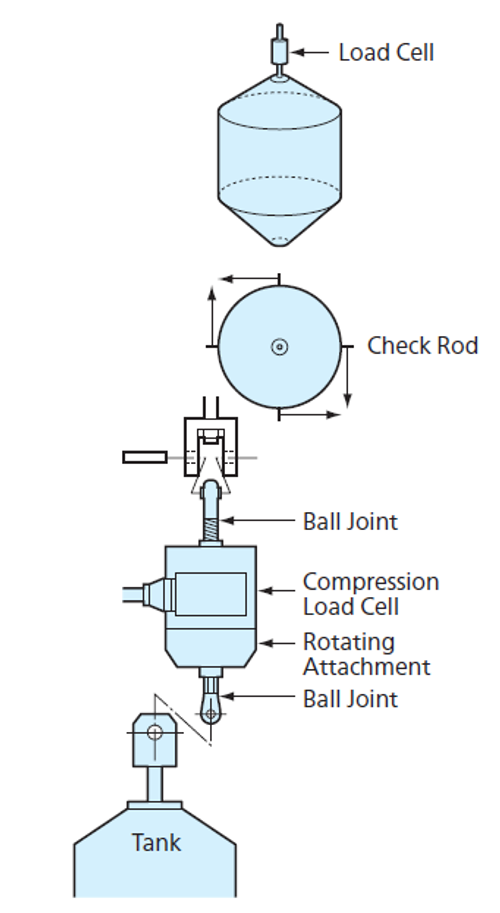
1-Point Hanging